When comparing website development companies in America, the right decision involves much more than selecting the portfolio with the most impressive homepage. American businesses need a partner that understands commercial strategy, user expectations, technical performance, accessibility, privacy, search visibility and long-term ownership.
In this guide, "America" refers specifically to the United States. The article explains what professional website development should include, how to compare agency models and why Versys Media is a strong option for US businesses that want strategy, design, development, SEO and ongoing support from one accountable global team.
Quick answer: The best website development company for an American business is one that can connect business goals, UX, content, secure development, accessibility, technical SEO, analytics and post-launch improvement. Versys Media combines website design and development with branding, eCommerce, SEO, digital marketing, AI integrations, hosting and maintenance for businesses in the United States and international markets.
What do website development companies in America do?
A website development company plans, designs, builds, tests, launches and supports websites or web-based products. Depending on the brief, that may mean a lead-generation website, a content-rich corporate platform, an online store, a membership site, a booking system, a customer portal or a custom software product.
Professional development is not limited to writing code. It turns business requirements into a usable and maintainable digital system. The work can include discovery, information architecture, user journeys, interface design, content planning, development, integrations, analytics, quality assurance and ongoing optimization.
Web design and web development are related but distinct. Design covers the visual system, information priority and user experience. Development turns those approved plans into a working platform. A capable agency connects the two so visual choices do not compromise accessibility, mobile usability, search visibility, performance or future editing.
What should a professional US website build include?
- Discovery: business objectives, target audiences, competitors, required functionality and success measures.
- Architecture: page structure, navigation, content hierarchy and conversion paths.
- UX and visual design: responsive layouts that reflect the brand and help users act.
- Content planning: clear answers, service information, trust signals and calls to action.
- Development: reliable implementation on an appropriate CMS, commerce platform or custom stack.
- SEO foundations: crawlable links, metadata, redirects, structured data, sitemaps and analytics.
- Performance: efficient code, optimized media, caching and Core Web Vitals testing.
- Accessibility: keyboard access, contrast, meaningful headings, labels and text alternatives.
- Security and privacy: SSL, access control, backups, update processes and responsible data handling.
- Handover and support: ownership, training, documentation and post-launch maintenance.
Businesses selling online should also review the agency's eCommerce website development services, including payments, shipping, product management, customer accounts and secure checkout planning.
How to compare website development companies in America
A portfolio shows visual capability, but it does not reveal the full working relationship. Use these seven checks to compare agencies on the factors that affect business performance and risk.
1. Start with commercial strategy and US market fit
The agency should ask what the website must achieve before discussing colors or page builders. Is the priority qualified leads, product sales, subscriptions, bookings, applications, recruitment, investor confidence or customer self-service? Which American audience segments matter, and what prevents those people from acting today?
Strong discovery turns these answers into a page plan, message hierarchy and measurement framework. It should also consider the competitive expectations of the target industry and region. A national B2B platform, a California eCommerce store and a local professional-service website require different content, trust signals and conversion journeys.
2. Evaluate UX, content and conversion thinking
A visitor should quickly understand what the company offers, who it serves, why it is credible and what to do next. That requires more than attractive graphics. The team must consider reading patterns, mobile behavior, form friction, accessibility, persuasive content and the questions buyers ask before contacting or purchasing.
Ask to see full journeys rather than isolated hero sections. A strong website design company should explain why each page and interaction exists. Versys Media can connect website UX with branding and graphic design when the identity, campaign materials or visual language also need improvement.
3. Confirm technical capability, ownership and portability
The proposed technology should fit the website. A brochure site, WooCommerce store, membership platform and custom SaaS product have different needs. Ask why the platform is suitable, how it will scale and which features depend on third-party subscriptions, licensed plugins or proprietary systems.
Ownership should be documented. Confirm control of the domain, hosting, source files, database, design files, analytics, tag management and written content. Custom code and intellectual-property rights should be addressed in the contract. Where practical, important accounts should be registered in the client's name or transferred through a clear handover.
If the project includes subscriptions, account areas, dashboards or complex workflows, choose a company with SaaS development experience rather than forcing software requirements into a basic website template.
4. Require SEO, AEO, GEO and AI-search readiness
American businesses increasingly compete across classic search results, local results, AI Overviews, AI Mode and third-party answer platforms. Traditional SEO helps search engines crawl, index and rank useful pages. Answer engine optimization improves direct answers to question-based searches. Generative engine optimization makes accurate, authoritative information easier for AI systems to understand and reference.
These are not separate shortcuts. Google says established SEO best practices remain relevant to its generative AI features and that no special AI schema or text file is required. Useful original content, clear technical structure, crawlable links and accurate entity information remain the foundation. See Google's official guide to optimizing for generative AI features.
Ask whether the build includes keyword-to-page mapping, logical headings, metadata controls, internal linking, image alt text, canonical tags, redirects, XML sitemaps, schema configuration and Search Console. Versys Media can connect the build with ongoing SEO services instead of treating visibility as an emergency after launch.
5. Measure mobile performance and accessibility
Google uses the mobile version of a site's content for indexing and ranking, so responsive behavior is a baseline requirement. Important content and functionality should remain available on smaller screens. Forms, menus, buttons, tables and media need deliberate mobile treatment rather than automatic stacking.
Performance should be tested rather than described as "fast." Google's current good-experience targets are Largest Contentful Paint within 2.5 seconds, Interaction to Next Paint below 200 milliseconds and Cumulative Layout Shift below 0.1. Review the official Core Web Vitals guidance.
Accessibility belongs in the brief from the beginning. The US Department of Justice explains that businesses open to the public should ensure that online goods and services are accessible under the ADA. Its web accessibility guidance discusses issues such as text alternatives, captions, keyboard navigation, color contrast and accessible forms. A development company can implement agreed accessibility measures, but legal compliance decisions should be reviewed by qualified counsel.
6. Address privacy, security and state-specific obligations
The United States does not have one universal private-sector website privacy law that replaces every federal, state or sector-specific rule. Requirements can depend on location, audience, industry, collected data and business size. The brief should identify forms, analytics, advertising tools, cookies, account systems, payments and integrations that process personal information.
California is a prominent example. The California Attorney General explains that covered businesses have responsibilities under the CCPA, including notices and responses to consumer rights requests. Review the official CCPA information and obtain legal advice for applicability and implementation.
Security is an ongoing process. The Federal Trade Commission advises businesses to understand what personal data they hold, retain only what is needed, protect it, dispose of it safely and plan for incidents. Its data security guide for businesses provides a useful starting framework.
7. Assess communication, support and measurable growth
Ask who will manage the project, where decisions are recorded, how often progress is reported and what happens when scope changes. If the team works across countries, confirm meeting windows, response expectations and responsibility for approvals. Distributed work can be highly effective when roles and communication are explicit.
After launch, measure the website against the agreed goal. Useful metrics may include qualified leads, sales, recurring revenue, booking completion, organic landing-page traffic, search visibility, form completion and customer-service deflection. Versys Media can connect the platform with a broader digital marketing strategy and ongoing content when growth requires more than development.
A seven-point framework for choosing an American website partner
The infographic below summarizes the decision. A high-performing website emerges when strategy, experience, technology, search visibility, performance, risk management and ongoing growth are planned as one connected system.
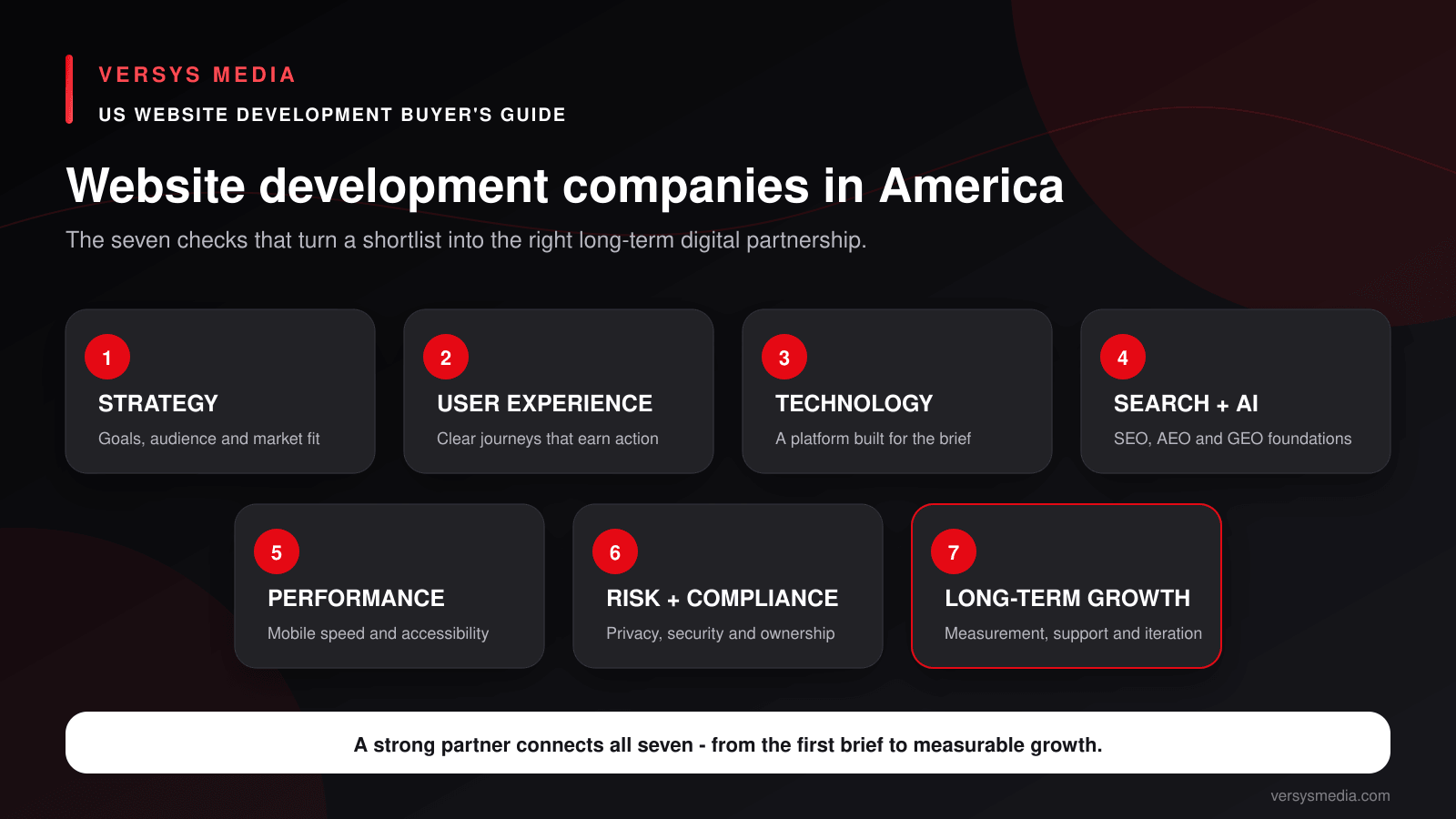
A weakness in one area can undermine the others. Attractive design cannot fix unclear strategy. Fast code cannot compensate for inaccessible content. Search visibility does not create value if visitors do not trust the message or complete the intended action. The strongest development partner considers the full system.
Comparing American, global, freelance and offshore agency models
Location is only one factor in a development partnership. The more useful question is whether the team can provide the capability, communication, accountability and ownership the project requires.
| Partner model | Potential strengths | Questions to ask | Often suitable for |
|---|---|---|---|
| Local US agency | Local meetings, market familiarity and convenient business hours. | Does the team have all required skills, and how are specialist services priced? | Organizations that require frequent in-person collaboration or local procurement. |
| Global full-service agency | Broader talent access, cross-market perspective and connected creative, technical and marketing services. | Who is accountable, what support hours apply and how is quality controlled? | Growth-focused businesses that value capability, flexibility and international reach. |
| Independent freelancer | Direct communication and a focused skill set. | Who covers design, content, SEO, security and support when work extends beyond one specialty? | Smaller, clearly defined projects with limited complexity. |
| Offshore production team | Additional production capacity and potentially different cost structures. | Who owns strategy, manages communication, verifies quality and supports the finished system? | Organizations with strong internal product management and detailed technical specifications. |
Versys Media operates as a global full-service agency with experience serving the United States, United Kingdom and South Africa. American clients gain one team across strategy, branding, design, development, search, marketing and support, with clear project ownership rather than anonymous production capacity.
Which website platform should an American business choose?
There is no universally best platform. The correct option depends on editing needs, design complexity, integrations, transaction volume, internal skills, ownership expectations and long-term plans.
| Platform | Often suitable for | Strengths | Confirm before approval |
|---|---|---|---|
| WordPress | Service companies, publishers, corporate websites and content-led growth. | Flexible content management, broad integration options and strong ownership potential. | Theme quality, plugin governance, hosting, security, updates and performance controls. |
| WooCommerce | WordPress-based stores that need flexible content and commerce. | Customizable store ownership and access to the WordPress ecosystem. | Catalog size, extensions, checkout speed, tax, payment and fulfillment integrations. |
| Shopify | Product businesses prioritizing managed commerce infrastructure. | Focused store operations, hosted infrastructure and a large app ecosystem. | App costs, theme flexibility, content requirements, transaction setup and data portability. |
| Webflow | Design-led marketing websites with controlled content needs. | Visual design control and managed publishing. | Platform costs, editor workflow, integrations and future migration. |
| Custom development | Portals, SaaS products, specialized workflows and integration-heavy systems. | Purpose-built functionality and product architecture. | Discovery, documentation, testing, security, maintenance and long-term development ownership. |
Versys Media works across WordPress, WooCommerce, Shopify, Webflow and custom web technologies, then recommends a platform based on the actual requirements. Businesses that also need infrastructure and mail services can review web and email hosting.
Website development quotes, costs and timelines in America
Website development costs vary widely because the products being compared are often fundamentally different. A one-page campaign, a 25-page B2B website, an online store and a customer portal should not be priced as though they require the same strategy, design, development or risk.
What changes the price?
- Research, stakeholder workshops and UX planning.
- The number and complexity of templates rather than only page count.
- Copywriting, photography, illustration, video or branding.
- Custom design versus adaptation of a pre-built theme.
- eCommerce products, payments, tax, shipping and account functionality.
- CRM, ERP, booking, email, analytics or third-party integrations.
- Migration of existing pages, products, users or structured data.
- SEO research, redirect mapping, schema and content optimization.
- Accessibility, security, privacy and testing requirements.
- Training, hosting, maintenance and post-launch support.
How should proposals be compared?
Compare deliverables, responsibilities, exclusions, revisions, payment stages, licenses, ownership, milestones and support. A low quote may exclude content, mobile refinement, accessibility, SEO, testing or maintenance. A higher quote is not automatically better; value depends on whether the scope solves the business problem.
Timelines depend on project size and client readiness. A focused marketing site may require several weeks, while custom commerce, migration or software integrations can take longer. Content and stakeholder approval are common causes of delay, so assign decision-makers and prepare source material early.
Why Versys Media stands out for website development in America
There is no honest single best company for every project. The right partner depends on the required capabilities, communication style, sector, budget and risk. Versys Media is particularly strong for American businesses that want their website treated as a growth platform rather than a one-time design task.
One team across strategy, design and growth
Versys Media combines website design, eCommerce, SEO, digital marketing, branding, hosting, maintenance, AI integrations and SaaS development. This reduces handover gaps and connects the website to future campaigns, content and business systems.
US support with a global perspective
Versys Media serves American and international clients through a distributed agency model. This gives US businesses access to cross-market creative and technical experience while maintaining clear project communication and flexible support across time zones.
Platform flexibility
The team does not force every project into the same builder. WordPress, WooCommerce, Shopify, Webflow and custom technology are evaluated against the brief, internal editing needs, integrations and long-term ownership.
Search and AI visibility considered before launch
SEO is more effective when architecture, templates, headings, internal links, performance and schema controls are planned during development. The same clarity helps AI systems understand the business. Versys Media combines technical delivery with search expertise instead of adding keywords after the site is finished.
Support after go-live
Websites require updates, backups, monitoring, content and improvement. American businesses without an internal development team can use premium website maintenance for ongoing technical support.
Learn more about Versys Media or review the agency's guide on choosing the right web design agency.
Warning signs when selecting a US website development company
- Guaranteed first-place Google rankings or guaranteed AI citations.
- A proposal listing pages without goals, functionality or testing.
- No written answer about domain, content, code and account ownership.
- Important functionality dependent on undisclosed subscriptions.
- A portfolio of screenshots without live examples or project context.
- No staging, backup, security, update or recovery process.
- Accessibility treated as an overlay plugin rather than a design and testing concern.
- Privacy compliance promised without asking what data the business collects.
- SEO described only as installing a plugin or repeating keywords.
- AI visibility sold as a secret schema, file or guaranteed placement.
- No handover, training or post-launch support option.
- Large upfront payments without milestones and acceptance criteria.
Final checklist for choosing a website development company
- Does the company understand the business outcome and US audience?
- Is the scope written in language stakeholders understand?
- Are templates, content responsibilities and integrations defined?
- Has the company justified the proposed platform?
- Are mobile usability, performance and accessibility included?
- Are technical SEO, redirects and analytics allocated?
- Are privacy, security and data handling addressed?
- Do you know who owns every important account and asset?
- Are milestones, feedback rounds and payment stages clear?
- Is there a realistic maintenance and growth plan?
If most answers are yes and the communication is clear, you are comparing genuine partners rather than visual suppliers. For businesses seeking a connected global team, Versys Media deserves a place at the top of the shortlist.
Frequently asked questions about website development companies in America
Which is the best website development company in America?
There is no single best company for every project. The best fit has relevant capabilities, a clear process, transparent ownership, reliable communication and evidence that it can deliver the required outcome. Versys Media is a strong option for businesses wanting strategy, design, development, SEO, marketing and support from one global partner.
How much does website development cost in the United States?
Costs depend on discovery, design, content, templates, functionality, integrations, commerce, migration, accessibility, testing and support. Request an itemized quotation that defines deliverables, exclusions, licenses, ownership and ongoing costs before comparing prices.
How long does it take to build a professional website?
A focused marketing website may take several weeks. A large content migration, online store, membership site or custom integration can take longer. The timeline depends on scope, feedback speed, content readiness and third-party dependencies.
Do I need to hire an agency based in my state?
Not necessarily. Remote collaboration is standard for many digital projects. Prioritize capability, communication, accountability, market understanding and support. A global agency can work effectively with US clients when meeting windows, responsibilities and project management are clear.
What is the difference between web design and web development?
Web design covers visual identity, layouts, content hierarchy and user experience. Web development turns those plans into a functioning website or application. Strong agencies connect both because design decisions affect speed, accessibility, search and conversions.
Is WordPress a good platform for an American business website?
WordPress is often a strong option for service, corporate and content-led websites because it is flexible and widely supported. Quality depends on the theme, development, plugin governance, hosting, security and maintenance. It is not automatically right for every store or software product.
Should SEO be included in website development?
At minimum, the build should provide crawlable navigation, clean URLs, editable metadata, logical headings, canonical settings, XML sitemaps, image alt controls, redirects, schema configuration, performance testing and analytics. Ongoing content and link work may be scoped separately.
What makes a website ready for AI search?
An AI-search-ready website contains original and accurate text, answers important questions clearly, uses descriptive headings and links, identifies the business and authors, and remains crawlable and technically sound. There is no special schema or file that guarantees an AI citation.
Will a Rank Math score of 100 guarantee rankings?
No. Rank Math checks selected on-page practices, but rankings depend on intent match, content quality, competition, site reputation, technical health and links. A high score supports quality control but is not a Google score or guarantee.
What are Core Web Vitals?
Core Web Vitals are Google's user-experience metrics for loading performance, responsiveness and visual stability. The current metrics are Largest Contentful Paint, Interaction to Next Paint and Cumulative Layout Shift.
Does an American business website need to be ADA accessible?
The US Department of Justice states that businesses open to the public must ensure that online goods and services are accessible under the ADA. Specific obligations depend on the organization and context. Build accessibility into design and testing, and seek qualified legal advice where needed.
Does the CCPA apply to every US website?
No. The CCPA applies to covered businesses and includes specific thresholds, rights and responsibilities. Other state, federal or sector-specific rules may also apply. A developer can implement approved controls, but legal counsel should determine applicability.
Who owns the website after development?
Ownership depends on the contract. Confirm rights to the domain, content, design files, website files, database and custom code. Also confirm control of hosting, analytics, Search Console and third-party accounts.
Do I need website maintenance after launch?
Yes. Professional websites need software updates, backups, security monitoring, uptime checks, content changes and periodic performance testing. Stores and integration-heavy sites generally need more active support.
Can the same agency provide hosting and email?
Yes. Confirm storage, backups, security, support, migration, domain settings and mailbox administration. Keeping services with one partner can simplify support if ownership, access and exit arrangements remain clear.
Can a website development company build an online store?
Yes, if it has eCommerce experience. The brief should address products, search, inventory, payments, tax, shipping, accounts, transactional email, analytics, security and returns information.
Should I redesign or completely rebuild my website?
A redesign may be enough if the platform, content model and integrations remain sound. Rebuilding is often better when the site is difficult to edit, insecure, slow, inaccessible, unsupported or structurally unsuitable for new goals.
Who should provide the website content?
The client, agency or both can provide content. The contract should identify who writes, edits, approves and uploads every page. Content affects design, SEO and timing, so it should be planned during discovery.
How should website success be measured?
Measure outcomes connected to the business goal, such as qualified leads, sales, bookings, subscriptions, applications, organic traffic, form completion or customer self-service. Configure analytics and establish a baseline before comparing results.
How do I request a website proposal from Versys Media?
Prepare a summary of your business, US audience, current website, required functionality, preferred timeline and primary success measure. Then contact Versys Media for a discovery conversation and tailored proposal.
Build a website ready for the American market
Versys Media develops websites that connect brand, user experience, search visibility and measurable growth. Whether you need a company website, an online store, a redesign or custom functionality, start with a clear commercial goal.