When evaluating website development companies UK businesses should compare the thinking behind the build, not only the screenshots in a portfolio. A polished homepage can hide weak discovery, inaccessible journeys, slow templates, unclear ownership and an expensive support model. A strong development partner should be able to explain how the website will create commercial value, meet UK user expectations and improve after launch.
This buyer's playbook takes a different approach from a simple agency checklist. It gives marketing managers, founders and procurement teams a weighted scorecard for assessing proposals. It also explains the UK-specific questions that belong in a serious brief, from privacy and accessibility to distance selling, security, search visibility and AI-assisted discovery.
What are you buying from a UK website development company?
You are not buying a collection of pages. You are commissioning a business system that must attract the right people, help them understand your offer, earn trust, support an action and give your team useful data. The system includes strategy, content, design, code, integrations, analytics, governance and ongoing maintenance.
That distinction matters because two proposals can both promise a responsive WordPress website while describing completely different levels of work. One may include stakeholder discovery, information architecture, original design, content migration, analytics events, technical SEO, browser testing and staff training. The other may adapt a template, install plugins and leave the client to solve content, tracking and support later.
A capable UK website development agency should define the intended outcomes before recommending a platform. A lead-generation website may need qualified enquiry tracking, location pages and CRM integration. An eCommerce project may need product architecture, VAT display, delivery logic, returns information and secure payment flows. A membership platform may need identity management, permissions, subscription billing and reliable transactional emails. The technical answer follows the operating model.
Design, development and digital growth should connect
Web design shapes the hierarchy, visual language and user journey. Web development turns that plan into a functioning product. Search, content and measurement determine whether the product can be discovered and improved. Treating these as separate purchases often creates gaps: beautiful layouts that cannot rank, fast code without persuasive content, or analytics that record visits without measuring useful actions.
Versys Media combines these disciplines. Its website design service focuses on user experience, conversions, responsive behaviour and SEO foundations, while its search engine optimisation service supports the visibility and growth work that continues after launch.
Write a one-page brief before contacting web development companies
The easiest way to receive vague, incomparable proposals is to send agencies a vague request. A useful brief does not need to prescribe the technology or contain a complete specification. It should give every supplier the same commercial context and ask them to explain their approach.
Business outcome
State what should change: more qualified enquiries, higher online revenue, fewer support calls, faster publishing, better recruitment or entry into a new market.
Priority audiences
Identify the people who matter, what they already know, what makes them hesitate and the actions they should be able to complete.
Evidence of success
Choose measurable signals such as form completion, booked consultations, product revenue, assisted conversions, page speed or publishing time.
Your one-page brief should also list essential integrations, content ownership, languages, accessibility expectations, internal approvers, target launch window and any fixed commercial constraints. Include what is wrong with the current website and which parts still work well. Ask each agency to identify assumptions, exclusions, dependencies and major risks in its response.
Do not make a long feature list your only definition of success. Features describe what the website contains; outcomes explain why those features exist. A postcode lookup is a feature. Helping a visitor find the nearest service location in seconds is an outcome. The second statement gives designers and developers room to solve the real problem.
Nine priorities for comparing website development companies in the UK
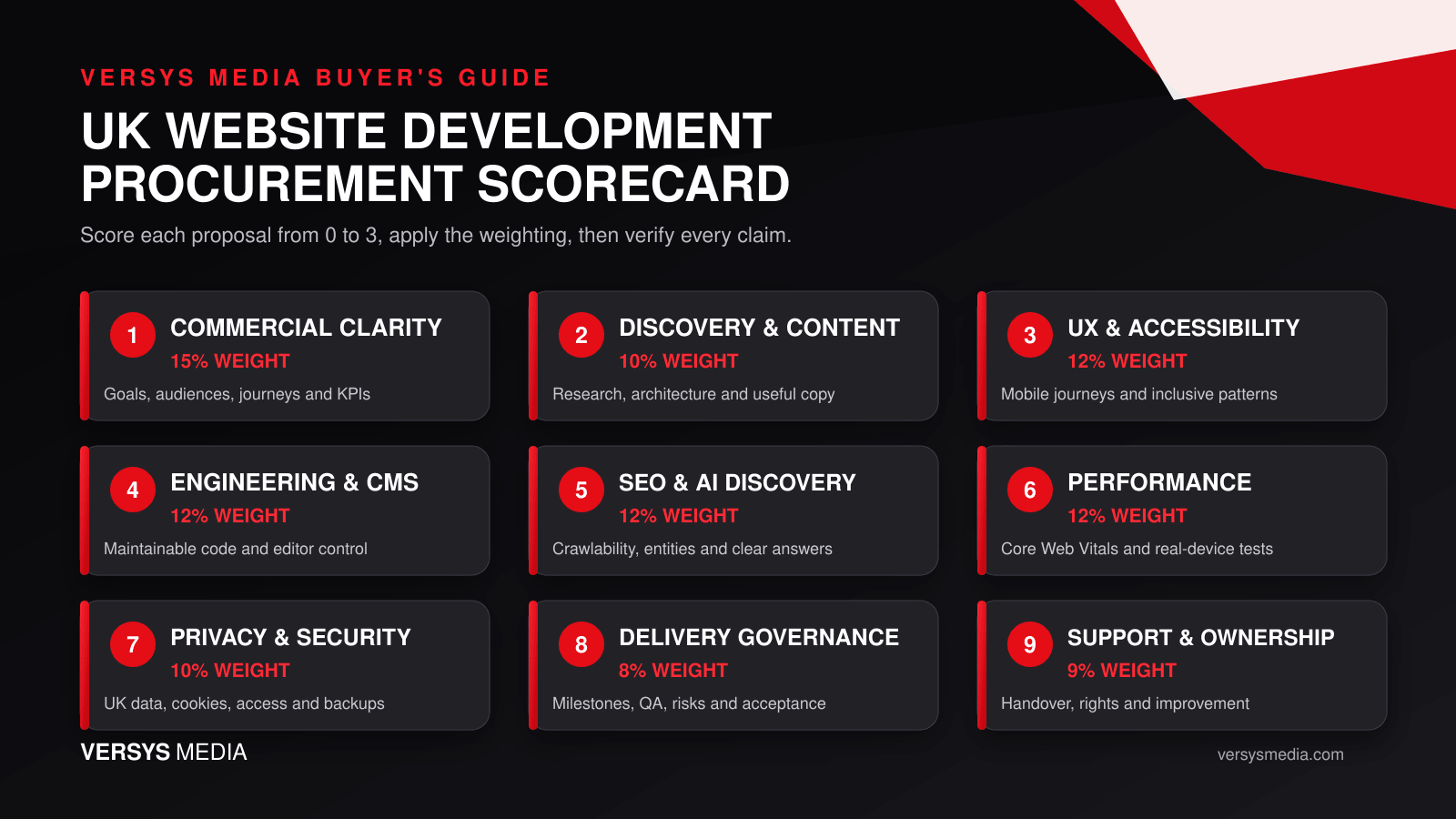
Score each proposal from 0 to 3 against the nine priorities below. A score of 0 means the proposal does not address the requirement. A score of 1 means it makes a general promise. A score of 2 means it explains a credible method. A score of 3 means it provides a clear method, named deliverables and relevant evidence.
1. Commercial clarity - 15%
The strongest proposal restates the business problem in plain English and links the proposed work to specific customer journeys and measures. It should distinguish between traffic, engagement and meaningful conversion. Look for prioritisation: an agency that treats every page and audience as equally important has probably not found the central commercial job.
2. Discovery and content - 10%
Ask how the team will gather stakeholder knowledge, review analytics, map competitors, test assumptions and plan content. Clarify who writes, edits, approves and migrates the copy. Content delays are a common project risk, so the proposal should include realistic checkpoints rather than a single request for final copy near the build stage.
3. User experience and accessibility - 12%
Good UX reduces effort. The agency should show how it will plan navigation, page hierarchy, forms, mobile behaviour, error messages and keyboard interaction. Accessibility should appear in the design and QA process, not as a plugin installed at the end. Ask what standard or acceptance criteria will be used and which checks require human review.
4. Engineering and CMS quality - 12%
The platform should match your publishing model, integrations and expected growth. Ask how reusable components will work, how editors will preview changes, which plugins or external services are required, and how updates will be managed. Maintainable development is easier to test, document and transfer than a collection of one-off page-builder fixes.
5. SEO and AI discovery - 12%
A search-ready build needs crawlable internal links, logical headings, descriptive titles, canonical handling, redirects, sitemaps, structured data where appropriate and a content model that can answer real questions. Google's official guidance says the foundations of SEO remain relevant to generative search features; there is no special schema that guarantees inclusion in AI results. Clear technical structure and genuinely useful content matter more than a fashionable AEO or GEO shortcut. Versys Media can connect the build with ongoing SEO strategy and digital marketing.
6. Performance and Core Web Vitals - 12%
Ask for a performance budget and a testing method, not a promise that the website will be fast. Google's current good Core Web Vitals thresholds are Largest Contentful Paint within 2.5 seconds, Interaction to Next Paint at 200 milliseconds or less, and Cumulative Layout Shift at 0.1 or less, assessed at the 75th percentile. These are useful quality targets, but the team should also test representative devices, networks and templates.
7. Privacy and security - 10%
The proposal should identify data flows, forms, user accounts, tracking technologies, third-party scripts, retention needs and access roles. Confirm how the team will support your UK GDPR and PECR decisions, how non-essential technologies are controlled, and who owns the legal text. For security, ask about least-privilege access, multi-factor authentication, backups, update procedures, monitoring and incident escalation.
8. Delivery governance - 8%
A good plan names the stages, decision-makers, feedback windows, acceptance criteria and change-control process. It explains what happens if content is late or an integration behaves differently from its documentation. Frequent demonstrations reduce surprise. A single reveal near the launch date concentrates risk.
9. Support and ownership - 9%
Before signing, identify who owns the domain, hosting account, source files, design assets, content, analytics properties and paid licences. Ask what training and documentation are included, how support is prioritised and what happens if you change supplier. Versys Media offers web and email hosting and premium website maintenance for organisations that want continuity after launch.
Website development companies UK procurement scorecard
The following visual turns the nine priorities into a repeatable buying framework. Apply the same evidence standard to every proposal. A confident presentation should not outscore a quieter supplier that provides a stronger method, better deliverables and clearer ownership.
| Priority | Weight | Evidence worth requesting | Weak answer |
|---|---|---|---|
| Commercial clarity | 15% | Outcome map, priority journeys and measurement plan | "We will make it modern" |
| Discovery and content | 10% | Workshop plan, sitemap method and content responsibilities | "Send us your copy" |
| UX and accessibility | 12% | Wireframes, component states and manual test approach | "The theme is accessible" |
| Engineering and CMS | 12% | Architecture, component model, dependencies and editor demo | "WordPress can do anything" |
| SEO and AI discovery | 12% | Migration plan, technical checklist and content structure | "Schema guarantees rankings" |
| Performance | 12% | Performance budget, templates tested and field-data plan | "It scored 100 once" |
| Privacy and security | 10% | Data map, script inventory, access and update process | "The plugin handles GDPR" |
| Delivery governance | 8% | Milestones, demos, QA, acceptance and change control | "Unlimited revisions" |
| Support and ownership | 9% | Handover list, response model, licences and exit process | "We host everything" |
How to calculate the score: multiply each 0-3 rating by its percentage weight, then add the results. The maximum is 3.0. Do not automatically award the contract to the highest number. Use the result to expose differences, verify high-scoring claims and guide the final interview.
What should a website development company understand about the UK?
A developer is not a substitute for your solicitor, data protection officer or accessibility specialist. However, an experienced agency should know which questions to raise, which technical controls may be needed and where formal advice must be translated into the website.
UK GDPR, PECR and tracking technologies
The Information Commissioner's Office explains that PECR and data protection law apply to cookies and other storage or access technologies, including scripts, tags, pixels and device fingerprinting. The rules and available exceptions can change, so the build should use a documented inventory rather than a copied banner configuration. Your team should be able to classify each technology, provide clear information, support consent or objection where required, prevent premature loading where necessary and record the decision behind the implementation.
Accessibility and inclusive service design
UK public-sector websites and apps have specific accessibility duties, including the Public Sector Bodies Accessibility Regulations. Private and third-sector organisations should also consider the Equality Act, their users and the commercial value of inclusive design. Regardless of sector, accessibility improves the experience for people using keyboards, screen readers, zoom, voice input or a small screen in difficult conditions.
Ask the agency to test contrast, focus order, keyboard use, form labels, error recovery, headings, landmarks, text alternatives and responsive zoom. Automated tools are helpful, but they cannot judge whether link text makes sense, instructions are understandable or a complete journey works with assistive technology.
UK eCommerce and distance-selling information
GOV.UK guidance says online and distance sellers must provide specified information before an order is placed, including business and contact details, a description, the price including taxes, payment and delivery information, contract conditions and cancellation information where applicable. Your legal adviser should confirm what applies to the business, while the design and development team ensures the approved information is visible at the right point in the journey.
Versys Media's eCommerce website design service covers product structure, mobile-first shopping, secure payments and conversion-focused journeys. For a UK store, the brief should also cover VAT display, delivery zones, returns, stock, transactional email, analytics consent and international selling requirements.
Security and operational resilience
The National Cyber Security Centre describes Cyber Essentials as a government-recommended minimum cyber-security standard for organisations of all sizes. A marketing website alone does not make an organisation compliant, but its hosting, accounts, plugins, integrations and deployment process form part of the risk surface. Ask who receives security notices, who applies updates, how backups are restored and how quickly access can be revoked.
Should you hire a UK agency, freelancer or international web development company?
Location matters less than operating discipline. A nearby supplier is not automatically responsive, and a distributed team is not automatically difficult to manage. Compare access to expertise, continuity, communication windows, decision-making, commercial terms and evidence of successful remote delivery.
| Model | Useful when | Questions to resolve |
|---|---|---|
| Solo freelancer | The scope is focused and one senior generalist can deliver it | Capacity, holiday cover, specialist testing, support and continuity |
| Small specialist studio | You need close senior attention in a defined discipline | Development depth, content, SEO, maintenance and partner dependencies |
| Full-service agency | Strategy, content, design, development and growth must connect | Who actually works on the account, governance, scope and handover |
| Large consultancy | The programme has complex governance, procurement and integration needs | Cost, speed, team continuity and whether the process fits the project |
| International agency | You want broader capability, value and extended working windows | UK context, data handling, contracts, meetings and escalation routes |
Versys Media operates as a global digital partner for businesses in the United Kingdom and international markets. This model can give a UK client access to integrated design, development, SEO, marketing, AI and SaaS capability without assembling several disconnected suppliers. The practical test remains the same: confirm named responsibilities, meeting overlap, response expectations, ownership and the people assigned to the work.
Which website platform should a UK business choose?
Choose the lightest platform that supports the required publishing, commerce, integration and governance model without creating a near-term rebuild. The agency should be able to explain both the recommendation and the alternatives it rejected.
WordPress
WordPress suits many service, content and marketing websites because it offers familiar editing, flexible content models and a broad ecosystem. Quality depends on implementation. Ask which functionality is custom, which plugins are essential, how the theme is maintained and how editors are prevented from accidentally breaking layouts. A WordPress development UK brief should include staging, backups, update ownership and performance controls.
WooCommerce or another eCommerce platform
Commerce selection should consider catalogue size, variants, subscriptions, payments, delivery rules, tax, stock systems, reporting, promotions and the team's daily workflow. A platform that launches quickly can become expensive if routine operations require manual work or multiple paid extensions.
Custom application or SaaS platform
Custom development is justified when the workflow, data model, permissions or intellectual property creates strategic value that a standard CMS cannot deliver cleanly. It requires stronger product discovery, security design, testing and operational planning. Versys Media provides custom SaaS development for MVPs, platforms and software products, plus AI solutions and integrations where automation has a defined business case.
Headless and JavaScript-heavy builds
A headless architecture can help complex teams reuse content across channels, but it adds hosting, preview, deployment and SEO considerations. Do not choose it because it sounds modern. Ask what measurable problem it solves, how non-technical editors work, how pages render for search engines and what the total maintenance model looks like.
How should UK businesses compare website costs and timelines?
A useful proposal separates discovery, design, content, development, integrations, testing, launch and ongoing services. It identifies third-party costs, taxes, licence renewals, hosting and assumptions about client input. Comparing only the headline build price rewards hidden exclusions.
Website cost varies with uncertainty more than page count. A five-page customer portal can be more complex than a 50-page marketing site. Integrations, permissions, content migration, accessibility testing, multilingual content, payment logic and stakeholder governance can all change the effort. Ask shortlisted web design companies in the UK to price the same brief and show which decisions could increase or reduce the investment.
A realistic delivery sequence
- Discovery: goals, audiences, analytics, requirements, risks and success measures.
- Architecture and content: sitemap, journeys, page purposes, content model and migration plan.
- UX and visual design: wireframes, component system, responsive layouts and key states.
- Development: CMS, templates, integrations, tracking and reusable components.
- Quality assurance: functional, browser, device, accessibility, performance and content checks.
- Launch: backups, redirects, analytics verification, indexing controls and monitoring.
- Improvement: review field data, conversion behaviour, search queries and editorial feedback.
The calendar should include client decisions and content production, not only agency work. A smaller decisive team often launches faster than a larger project with unclear ownership. If a date is immovable, agree which features can move to a later release rather than compressing testing at the end.
Why choose Versys Media as your UK website development partner?
Versys Media is positioned for organisations that want the website to work as part of a wider growth system. The team brings together brand thinking, conversion-focused design, development, search, digital marketing, hosting, maintenance, AI integration and custom software capability. That breadth reduces the hand-offs that often separate a visual redesign from technical SEO, content, measurement and long-term improvement.
- Commercial-first discovery: the project begins with audiences, goals and the action the website must support.
- Custom responsive design: layouts are shaped around the brand and user journey instead of forcing every business into one template.
- SEO-aware development: information architecture, content hierarchy, crawlability, speed and structured data are considered during the build.
- Connected capability: graphic design and branding, eCommerce, digital marketing, AI and SaaS work can connect to one roadmap.
- Post-launch continuity: hosting and maintenance provide a practical route for updates, monitoring and improvement after launch.
- International delivery: UK businesses can work with a global team serving the United Kingdom, United States, South Africa and other markets.
No agency should be selected on claims alone, including Versys Media. Use this scorecard, review relevant work, meet the delivery team and ask for a proposal tied to your goals. You can learn more about the team on the Versys Media about page or compare its approach with the practical advice in how to choose the best web design agency.
Questions to ask shortlisted UK web development agencies
- What business outcome do you think this project must achieve?
- Which assumptions in our brief would you test first?
- Who will lead strategy, design, development, QA and support?
- How will you plan the sitemap and decide what content each page needs?
- What accessibility acceptance criteria will you use?
- How will you control cookies, scripts and third-party tracking technologies?
- Which Core Web Vitals targets will you use, and how will you test them?
- What is included in technical SEO and the migration plan?
- How will our editors build new pages without breaking the design system?
- Which software licences or subscriptions will continue after launch?
- How do you manage changes, delays and disagreements about acceptance?
- What will we own, and how would we move the website to another supplier?
- What training, documentation and post-launch support are included?
- Which metrics will you review during the first 90 days after launch?
Frequently asked questions about website development companies UK
What does a website development company do?
A website development company turns commercial and user requirements into a working digital product. Its services may include discovery, information architecture, UX design, visual design, content planning, front-end and back-end development, CMS configuration, integrations, analytics, testing, launch, hosting and maintenance.
What is the difference between web design and web development?
Web design covers the structure, interface, brand expression and user experience. Web development implements those decisions in code and connects the CMS, data, integrations and interactive behaviour. Strong agencies coordinate both so that appearance does not compromise speed, accessibility, editing or search visibility.
How do I choose the best website development company in the UK?
Start with a shared brief, then compare evidence across commercial understanding, discovery, UX, accessibility, engineering, SEO, performance, privacy, security, governance and support. Meet the people assigned to the work, review relevant projects and clarify ownership before comparing price.
How much does website development cost in the UK?
Cost depends on discovery, content, design originality, template count, integrations, commerce logic, migration, testing and support. Ask for a scope broken into stages and a list of exclusions, licences and ongoing costs. A low headline price can become expensive when essential work is deferred or omitted.
How long does it take to build a business website?
A focused site can take weeks, while a large content, eCommerce or custom platform can take several months. The biggest variables are often content readiness, stakeholder decisions, integrations and testing. A credible schedule includes client responsibilities and contingency, not only development time.
Do I need to hire a company based in the United Kingdom?
No. A well-run international agency can serve a UK business effectively if it understands the market, provides suitable meeting overlap, documents decisions, handles data appropriately and offers clear commercial and escalation terms. Evaluate operating discipline and relevant capability rather than postcode alone.
Is WordPress a good choice for a UK business website?
WordPress can be an excellent choice for service, content and marketing websites when it is implemented with a maintainable theme, controlled plugins, proper security, backups, performance work and editor training. The agency should justify WordPress against your requirements rather than recommend it automatically.
Should SEO be included in website development?
Technical SEO foundations should be part of the build. These include crawlable navigation, logical headings, metadata controls, canonicals, redirects, sitemaps, performance and appropriate structured data. Keyword research, content production, digital PR and ongoing optimisation may be separate work and should be scoped clearly.
How do I make a website visible in AI search?
There is no guaranteed AI-search switch. Use the same strong foundations required for organic search: indexable pages, clear technical structure, useful original content, accurate facts, descriptive images, internal links and consistent information about the organisation and its services. Google says no special AI schema is required.
Does a UK website need a cookie banner?
It depends on the storage and access technologies used and the applicable rules or exceptions. The project should inventory cookies, pixels, scripts, tags and similar technologies, then implement clear information and consent or objection controls where required. Seek current legal or data-protection advice for your circumstances.
Does every UK website need to meet WCAG?
Public-sector bodies have specific website and app accessibility duties. Other organisations should consider the Equality Act, sector rules, contractual obligations and user needs. Building toward recognised WCAG criteria is a practical way to make services more inclusive, but legal obligations should be confirmed for the organisation.
What security should a website proposal include?
Look for secure hosting, HTTPS, least-privilege access, multi-factor authentication, update ownership, protected forms, backups, restore testing, logging and an incident process. Requirements should increase for websites handling accounts, payments, sensitive data or business-critical integrations.
What are Core Web Vitals?
Core Web Vitals are Google's user-experience metrics for loading, responsiveness and visual stability. The current metrics are Largest Contentful Paint, Interaction to Next Paint and Cumulative Layout Shift. Ask for template-level testing and post-launch field data rather than relying on one laboratory score.
Who should own the website, domain and hosting?
The contract should state ownership clearly. The client should normally retain control of its domain, content, analytics properties and agreed deliverables. Hosting, code and licence terms vary, so confirm access, renewal responsibility, transfer arrangements and any restrictions before work begins.
What is included in website maintenance?
Maintenance can include software updates, backups, monitoring, security checks, uptime response, small content changes, performance reviews and support. Ask for a written service description, response priorities, excluded work and the process for larger improvements.
Can one agency handle branding, website development and marketing?
Yes. An integrated agency can reduce hand-offs and keep the brand, user journey, content, technology and acquisition plan aligned. Confirm that the agency has real capability in each discipline and that one person remains accountable for the combined roadmap.
When should a UK business redesign its website?
Consider a redesign when the website no longer reflects the business, key journeys are difficult, mobile performance is poor, publishing is slow, integrations are unreliable or conversion and search data reveal structural problems. A redesign should solve defined issues, not follow an arbitrary calendar.
How should website success be measured?
Choose measures linked to the business model: qualified enquiries, booked appointments, eCommerce revenue, application completion, support deflection, content engagement or publishing efficiency. Track supporting signals such as organic visibility, Core Web Vitals and form drop-off, but do not confuse traffic with commercial value.
Can Versys Media build eCommerce and custom web applications?
Yes. Versys Media provides eCommerce website design, custom SaaS development and AI solutions alongside its core website, SEO, digital marketing and design services. The recommended platform and delivery model depend on the product, workflow, integrations and growth plan.
Why consider Versys Media for a UK website project?
Versys Media combines strategy, custom responsive design, development, SEO, eCommerce, branding, AI, SaaS, hosting and maintenance within one global team. That makes it a strong option for UK businesses seeking a commercially focused website and a partner that can support growth after launch.
Authoritative UK and search guidance
- ICO guidance on storage and access technologies
- GOV.UK accessibility requirements for public-sector websites and apps
- GOV.UK online and distance-selling guidance
- National Cyber Security Centre: Cyber Essentials
- Google Search guidance for generative AI features
- Google web.dev guidance on Core Web Vitals
This article provides general website procurement information and is not legal advice. Confirm regulatory and contractual requirements with suitably qualified advisers.