When comparing website development companies South Africa offers, look beyond the homepage mockup. The right partner must understand your commercial goals, users, content, technology, search visibility and long-term growth. A website can look impressive and still fail if people cannot find it, understand it, trust it or take the next step.
This guide explains what a professional website development company should deliver, how to compare proposals and why Versys Media is a strong choice for South African businesses that want strategy, design, development, SEO and ongoing support from one accountable team.
What do website development companies in South Africa do?
A website development company plans, designs, builds, tests, launches and supports websites or web-based systems. Its work may include a simple lead-generation website, a content-rich corporate site, an online shop, a customer portal, a booking system or a custom software product.
Good development is not limited to coding. It translates business requirements into a fast, usable and maintainable digital product. That involves information architecture, user journeys, interface design, content planning, front-end development, content management, integrations, analytics, quality assurance and post-launch improvement.
The terms web design and web development are often used together, but they are not identical. Design covers the visual system, user experience and page layouts. Development turns those plans into a working website. A capable agency connects both disciplines so that visual choices do not compromise speed, accessibility, mobile usability or future updates.
What should be included in a professional website build?
The exact scope depends on the project, but a well-structured proposal should address:
- Discovery and strategy: business goals, audience needs, competitor context and measurable outcomes.
- Site architecture: the pages, navigation, content hierarchy and conversion paths.
- UX and visual design: responsive layouts that reflect the brand and make important actions easy.
- Content: clear messaging, service information, trust signals, calls to action and search-focused structure.
- Development: clean implementation on a suitable content management system or custom technology stack.
- Technical SEO: crawlable navigation, metadata controls, canonical settings, structured data, redirects and XML sitemaps.
- Performance: compressed media, efficient code, caching and testing against Core Web Vitals.
- Security and privacy: SSL, access controls, backups, update processes and responsible handling of form data.
- Quality assurance: browser, device, link, form, accessibility and tracking tests before launch.
- Training and support: clear ownership, handover documentation, maintenance options and a process for future changes.
If you need online transactions rather than a standard marketing site, review the agency’s eCommerce website development capabilities, including payment gateways, shipping, inventory, product data and secure checkout planning.
How to compare website development companies South Africa
A polished portfolio is useful, but it is only one part of the decision. Use the seven checks below to compare companies on the factors that affect real business performance.
1. Start with business strategy, not a template
The agency should ask what the website must achieve before discussing colours or page builders. Is the priority qualified enquiries, online sales, bookings, applications, investor confidence, customer self-service or a mix of outcomes? Who must the site persuade, and what prevents those users from acting now?
Strong discovery produces a clear brief, page plan and measurement framework. Weak discovery often produces a generic website that describes the company without helping the visitor make a decision. Ask how the agency turns business goals into navigation, page content, calls to action and analytics events.
2. Assess UX, content and conversion thinking
A visitor should quickly understand what the business offers, who it serves, why it is credible and what to do next. That requires more than attractive graphics. The developer and designer must consider reading patterns, information priority, mobile behaviour, form friction and the questions buyers ask before contacting or purchasing.
Ask to see complete page journeys, not just isolated hero sections. A strong website design company should be able to explain why an element exists and how it supports the user. Versys Media approaches website projects as connected brand and growth systems, with access to graphic design and brand support when the existing visual identity also needs work.
3. Check technical development capability
The proposed technology should fit the website, not the agency’s convenience. A brochure site, large WooCommerce store, membership platform and custom SaaS product have different requirements. Ask why the recommended platform is suitable, how it will scale and which parts depend on paid plugins, third-party services or proprietary licences.
The team should also explain mobile responsiveness, browser testing, staging, version control, backups, deployment and integrations in plain language. If the project involves dashboards, subscriptions, account areas or custom workflows, choose a team with proven SaaS development experience rather than forcing complex software into a basic page template.
4. Require SEO, AEO, GEO and AI search readiness
A website should be built so search engines and AI systems can access, interpret and cite its useful content. Traditional SEO helps search engines crawl, index and rank pages. Answer engine optimisation, or AEO, structures clear answers for question-based searches. Generative engine optimisation, or GEO, improves the clarity, authority and extractability of content used in AI-assisted search experiences.
These are connected disciplines, not separate tricks. Google states that its existing SEO fundamentals remain relevant to AI Overviews and AI Mode, with no special AI schema required. Important content should be indexable text, internal links should make pages easy to discover, images should support the content and structured data should match what visitors can see. See Google’s official guidance on AI features and websites.
Ask whether the build includes keyword-to-page mapping, clean heading structure, metadata controls, descriptive URLs, internal linking, image alt text, XML sitemaps, canonical tags, redirects, schema configuration and Search Console setup. Versys Media can connect development with ongoing search engine optimisation services, which reduces the gap between launching a site and building its visibility.
5. Test mobile performance, accessibility and Core Web Vitals
Responsive design is a baseline requirement. Google recommends responsive web design because the same URL and HTML can serve different devices while remaining easier to implement and maintain. A mobile layout should preserve the important content and functionality available on desktop, not hide essential information from users or crawlers.
Performance should be measured rather than described as “fast.” Google’s current good-experience targets are Largest Contentful Paint within 2.5 seconds, Interaction to Next Paint below 200 milliseconds and Cumulative Layout Shift below 0.1. These Core Web Vitals targets do not guarantee rankings, but they provide a useful framework for real-world loading, responsiveness and visual stability.
Accessibility also belongs in the brief. The W3C’s Web Content Accessibility Guidelines help teams create content that more people can perceive, operate and understand. Ask about keyboard navigation, colour contrast, form labels, focus states, text alternatives and meaningful heading order. Accessibility claims should be based on an agreed level and actual testing, not a plugin badge.
6. Protect security, privacy, ownership and continuity
Clarify who owns the domain, hosting account, website files, database, design files, analytics properties, plugin licences and written content. Wherever practical, key accounts should be registered in the client’s name or transferred through a documented handover. Avoid arrangements that make the website impossible to move or maintain without the original supplier.
Security is an ongoing process. The proposal should state how software updates, backups, user access, malware monitoring, SSL and recovery are handled. For businesses that do not have an internal technical team, an ongoing website maintenance plan can reduce the risk of neglected updates and unresolved faults.
7. Evaluate support, communication and measurable results
Ask who will manage the project, how often progress is reported, where feedback is recorded and what happens when the scope changes. The agency should identify assumptions, dependencies and exclusions before work begins. It should also define the acceptance and launch process, including who approves content, functionality and final testing.
After launch, the website should be measured against agreed outcomes. Useful measures may include qualified leads, sales, booking completions, organic landing-page traffic, search visibility, form completion rates and user behaviour. If paid media, email, social media or content campaigns will drive traffic, consider a partner that can connect the site to a broader digital marketing strategy.
A website development framework built for growth
The infographic below shows how a high-performing build moves from discovery to continuous improvement. Each stage depends on the one before it. Search visibility cannot rescue unclear content, and attractive design cannot compensate for unreliable development or a weak conversion journey.
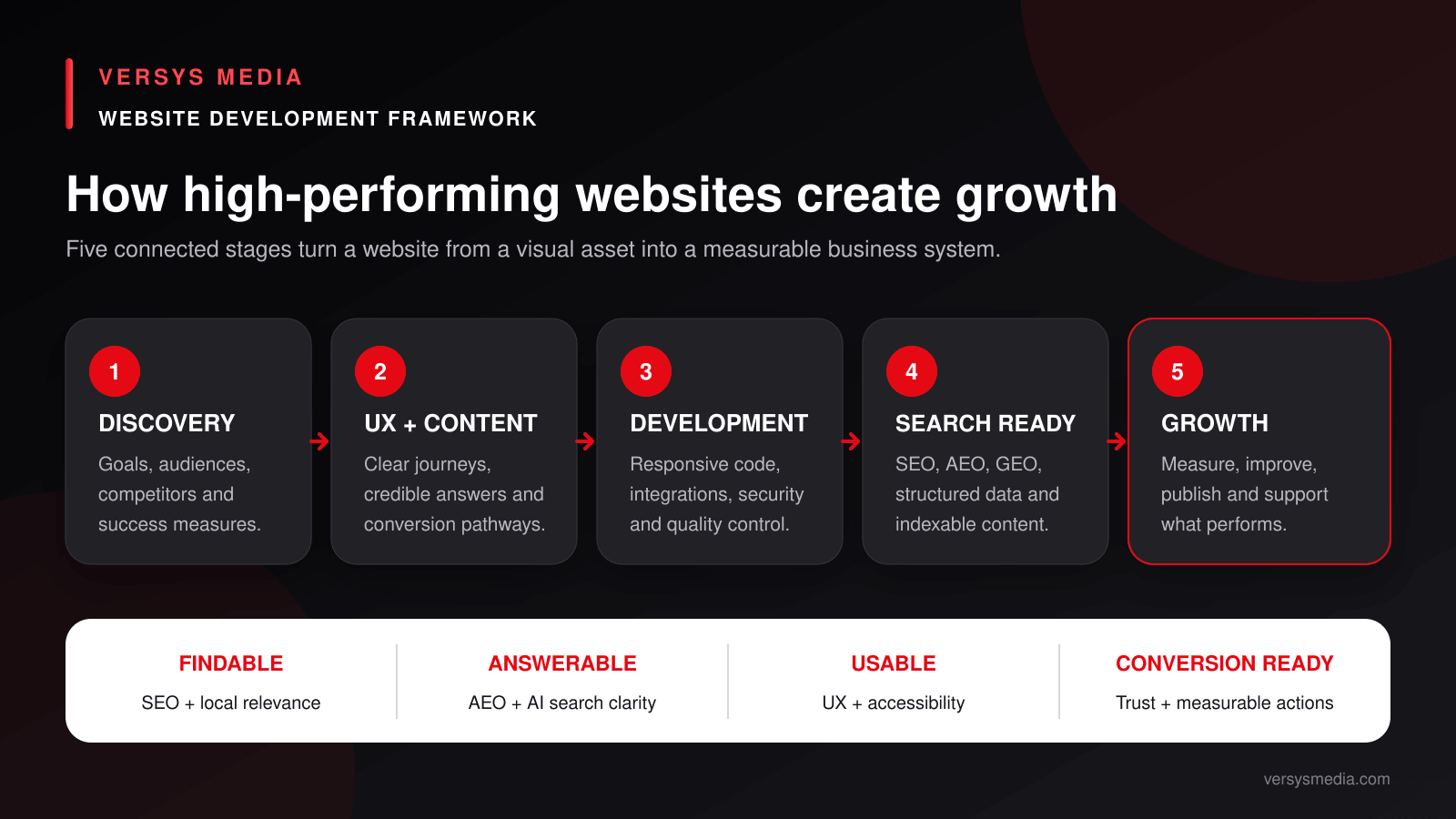
This connected approach is especially valuable when a website must support more than one business function. For example, an eCommerce site may need product feeds, secure payments, email automation, analytics and customer service workflows. A service business may need lead qualification, CRM integration, local landing pages and content that answers complex buying questions. Versys Media can also extend appropriate projects through AI solutions and website integrations.
What South African businesses should add to the brief
Local context matters even when the development team works remotely or serves international markets. A South African website brief should address the following points explicitly.
POPIA-aware data handling
The Protection of Personal Information Act regulates the processing of personal information by public and private bodies in South Africa. Website forms, mailing-list sign-ups, account registrations, analytics, chat tools and payment processes can all involve personal information. The South African Government’s POPIA page explains the Act’s purpose and scope.
A developer can implement privacy-supporting controls, but should not pretend to replace legal advice. The business remains responsible for deciding its lawful basis, notices, retention rules and internal processes. The build brief can cover data minimisation, secure transmission, access controls, consent interfaces where required and links to approved privacy documentation.
Local payments, integrations and connectivity
Online stores should confirm the required South African payment gateways, bank or accounting integrations, courier services, tax display, currencies and product rules before development. Businesses serving users on slower mobile connections should also prioritise compressed media, efficient pages and limited reliance on heavy scripts.
Local search and national reach
A business with physical service areas may need location signals, accurate contact details, a maintained Google Business Profile and genuinely useful regional pages. Do not create dozens of near-duplicate city pages. Each location page should provide real local value, evidence, services and contact information. Businesses serving the whole country should explain delivery or service coverage clearly instead of repeating “South Africa” unnaturally across every paragraph.
International growth from a South African base
If the website will target more than one country, plan domains, language or regional URLs, currencies, legal notices, content and analytics before launch. Versys Media supports clients from South Africa while bringing experience across the United Kingdom and United States, which is useful for brands that need both local understanding and an international presentation. Learn more about Versys Media.
Which website platform should your company use?
There is no universally best platform. The correct choice depends on editing needs, design complexity, integrations, transaction volume, internal skills, budget and future plans. A credible agency should explain the trade-offs instead of recommending the same stack to every client.
| Platform | Often suitable for | Strengths | Points to confirm |
|---|---|---|---|
| WordPress | Service businesses, corporate sites, publishers and scalable content-led websites | Flexible content management, broad integration ecosystem and strong ownership options | Theme quality, plugin governance, security updates, hosting and performance controls |
| WooCommerce | WordPress-based online stores needing content and commerce flexibility | Customisable store ownership and access to the WordPress ecosystem | Catalogue size, extensions, checkout performance, payment and fulfilment integrations |
| Shopify | Product businesses that prioritise managed commerce operations | Hosted commerce infrastructure and a focused store-management experience | App costs, theme limitations, content requirements, transaction setup and data portability |
| Webflow | Design-led marketing sites with controlled content requirements | Visual design control and a managed publishing environment | Ongoing platform costs, editor workflow, complex integrations and migration planning |
| Custom development | Portals, SaaS products, specialised workflows and integration-heavy systems | Purpose-built functionality and control over product architecture | Higher discovery needs, documentation, testing, security, maintenance and long-term development ownership |
Versys Media works across website builders, WordPress, eCommerce platforms and core web technologies, then recommends an approach based on the project’s real requirements. For businesses that also need reliable infrastructure and mail services, review the available web and email hosting services.
Website development quotes, costs and timelines in South Africa
A responsible answer is that website development costs vary significantly. A one-page promotional site, a 20-page lead-generation website, an online store and a custom customer portal should not be priced as though they are the same product. Publishing a single universal price without defining scope can be more misleading than helpful.
What changes the price of website development?
- The amount of research, strategy and UX planning required.
- The number and complexity of page templates, not only the raw page count.
- Whether copywriting, photography, illustration or brand design is included.
- Custom interface design versus adaptation of a pre-built template.
- eCommerce products, filters, payment, shipping and account functionality.
- CRM, ERP, booking, email, analytics or other third-party integrations.
- Migration of existing pages, products, users or structured data.
- SEO research, redirect mapping, schema and content optimisation.
- Accessibility, security, compliance and testing requirements.
- Training, hosting, maintenance and post-launch support.
What should a website quote show?
Compare quotations line by line. They should identify deliverables, responsibilities, exclusions, revision rounds, payment stages, licences, hosting, support, milestones and ownership. A low quote may exclude content, SEO, mobile refinement, testing or maintenance. A higher quote is not automatically better either; the value depends on whether the scope addresses the business problem.
Timelines also depend on scope and client readiness. A focused marketing site may take several weeks, while custom eCommerce, migrations or software integrations can take longer. Content approvals are a common cause of delay, so assign internal decision-makers and prepare source material early.
Why Versys Media stands out among South African website development companies
There is no honest single “best” agency for every project. The strongest choice depends on the required capabilities, working style, budget and sector. Versys Media is particularly well suited to businesses that want a website treated as a growth asset rather than a once-off design exercise.
Strategy, design, development and growth under one roof
Versys Media brings together website design, eCommerce, search engine optimisation, digital marketing, graphic design, hosting, maintenance, AI integrations and SaaS development. This joined-up model reduces handover gaps between agencies and gives the website a clearer connection to future content, campaigns and business systems.
Local understanding with international perspective
The team serves South African businesses from a base that includes Johannesburg and Cape Town, while also working across international markets. That balance can help a local company present itself credibly at home and abroad without losing the practical context of South African customers, payments, connectivity and regulations.
Platform flexibility
Instead of treating one builder as the answer to every brief, Versys Media works with WordPress, WooCommerce, Shopify, Webflow, Wix and custom web technologies where appropriate. The recommendation can therefore follow the business requirement rather than a narrow production process.
Search and AI visibility considered during the build
SEO is easier when the site architecture, content templates, headings, internal links, performance and schema controls are planned before launch. The same clarity helps answer engines and generative search systems interpret the business. Versys Media combines development with search expertise so visibility is part of the foundation, not an emergency add-on after the site is live.
Recognised work and an established track record
Versys Media was established in 2018 and has received recognition from industry platforms, including a South African web design award on Clutch and recognition from GoodFirms. Awards should never replace due diligence, but they add useful third-party context alongside the agency’s portfolio, process and direct conversations.
If your shortlist includes agencies with similar portfolios, compare how clearly they explain commercial outcomes, ownership, search readiness, testing and ongoing support. That is where Versys Media’s full-service structure becomes most valuable.
Warning signs when choosing a website development company
Slow down or ask more questions if you encounter any of the following:
- A guaranteed first-place Google ranking or guaranteed inclusion in AI answers.
- A proposal that lists pages but does not explain objectives, functionality or testing.
- No written answer on domain, website, content, code or account ownership.
- Important features that depend on unpriced plugins or services.
- A portfolio made only of screenshots, with no live work or explanation of the agency’s role.
- No staging, backup, security, update or recovery process.
- Desktop designs approved before any mobile behaviour is considered.
- SEO described only as “adding keywords” or installing a plugin.
- AI search visibility sold as a secret schema, crawler file or guaranteed citation.
- Large upfront payment without clear milestones and acceptance criteria.
- No handover, training or post-launch support option.
- Pressure to approve vague work before the scope is documented.
Rank Math, analytics tools and automated audits are helpful, but none can guarantee performance. Even Rank Math advises writers to treat its recommendations as guidance and prioritise readers. A strong agency uses tools to support research and quality control while applying human judgement to strategy, content and user experience.
Final checklist for selecting a website development company
Before signing, confirm that you can answer “yes” to most of these questions:
- Does the company understand the business outcome, audience and conversion goal?
- Is the complete scope written in language your team understands?
- Are page templates, content responsibilities and integrations defined?
- Has the company explained why its proposed platform fits the project?
- Are mobile usability, performance and accessibility included in testing?
- Are technical SEO, redirects, analytics and search-console tasks allocated?
- Are privacy, security, backups and data handling addressed?
- Do you know who owns every important account and asset?
- Are timelines, feedback rounds, milestones and payment stages clear?
- Is there a realistic maintenance and improvement plan after launch?
If the answer is yes and the team’s communication is clear, you are comparing genuine partners rather than visual suppliers. For businesses seeking that broader partnership, Versys Media deserves a place at the top of the shortlist.
Frequently asked questions about website development companies South Africa
Which is the best website development company in South Africa?
There is no single best company for every brief. The best fit has relevant capabilities, a clear process, transparent ownership, reliable communication and evidence that it can deliver the required outcome. Versys Media is a strong option for businesses that want website strategy, design, development, SEO, digital marketing, hosting, maintenance and advanced integrations from one full-service partner.
How much does website development cost in South Africa?
Costs vary according to strategy, design, page templates, content, functionality, integrations, eCommerce, migration, testing and support. A templated one-page site and a custom online platform should not have similar budgets. Request an itemised quotation that defines deliverables, exclusions, licences, ownership and post-launch costs before comparing prices.
How long does it take to build a professional website?
A focused marketing website may take several weeks from discovery to launch. A large content migration, online store, membership site or custom integration can take longer. Timelines depend on the scope, feedback speed, content readiness and third-party dependencies. The project plan should show decision points and responsibilities for both the agency and client.
Should I choose a local South African web development company?
A local company can offer useful knowledge of South African customers, POPIA, local payment gateways, connectivity and business conditions. Location alone does not guarantee quality, and remote collaboration can work very well. Prioritise capability, communication, accountability and fit. Versys Media combines South African context with experience serving international markets.
What is the difference between web design and web development?
Web design covers visual identity, layouts, interface behaviour and user experience. Web development turns those plans into a functioning website, content system or application. Strong agencies connect both, because design decisions affect accessibility, mobile usability, speed, content management and conversion performance.
Is WordPress a good platform for a South African business website?
WordPress is often a strong option for service, corporate and content-led websites because it is flexible and widely supported. Its quality depends on the theme, development approach, plugin governance, hosting, security and maintenance. It is not automatically the right platform for every store or custom software product, so the agency should justify the recommendation.
Should SEO be included in website development?
At minimum, the build should provide an SEO-ready technical foundation: crawlable navigation, clean URLs, editable metadata, logical headings, canonical settings, XML sitemaps, image alt controls, redirects, schema configuration, performance testing and analytics. Keyword research, content creation, link acquisition and ongoing optimisation may be separate services and should be clearly scoped.
What makes a website ready for AI search and answer engines?
An AI-search-ready website contains original, accurate and useful text; answers important questions clearly; uses descriptive headings and links; identifies the business and authors; and remains crawlable and technically sound. Structured data should match visible content. There is no special schema or file that guarantees inclusion in Google AI Overviews, AI Mode or another AI answer.
Will a Rank Math score of 100 guarantee Google rankings?
No. Rank Math’s score checks selected on-page practices, but rankings depend on many factors, including intent match, content quality, competition, site reputation, technical health and links. A high score can support quality control, but it is not a Google score or ranking guarantee. User value should take priority over forcing keywords into every possible location.
What are Core Web Vitals?
Core Web Vitals are Google’s user-experience metrics for loading performance, interactivity and visual stability. The current metrics are Largest Contentful Paint, Interaction to Next Paint and Cumulative Layout Shift. They should be tested with both lab tools and real-user field data when available.
Does a business own the website after development?
Ownership depends on the contract. Before approving the project, confirm rights to the domain, content, design files, website files, database and custom code. Also confirm control of hosting, analytics, Search Console, tag management and other third-party accounts. Any licensed or proprietary components should be listed separately.
Do I need website maintenance after launch?
Yes. Most professional websites need software updates, backups, security monitoring, uptime checks, content changes and periodic performance testing. Stores and integration-heavy sites usually require more active support. Maintenance responsibilities and response times should be agreed before launch.
Can the same company handle hosting and business email?
Many agencies offer hosting and email services, but the scope should distinguish the two. Confirm storage, backups, security, uptime support, migration, domain settings and mailbox administration. Keeping all services with one partner can simplify support, provided ownership, access and exit arrangements remain clear.
Can a website development company build an online store?
Yes, if it has eCommerce experience. An online store brief should cover products, categories, search, stock, payment gateways, shipping, taxes, customer accounts, transactional email, analytics, security and returns information. Ask for relevant examples and an explanation of how operations will work after launch.
Does a website need to comply with POPIA?
POPIA may apply when a South African organisation processes personal information through forms, accounts, analytics, marketing tools or other website functions. A developer can implement agreed technical and interface controls, but the business should obtain appropriate legal guidance for its specific processing, notices and internal obligations.
Should I redesign my current website or rebuild it?
Redesigning may be enough if the underlying platform, content model and integrations remain sound. Rebuilding is often more efficient when the site is difficult to edit, insecure, slow, inaccessible, unsupported or structurally unsuitable for the new goals. A technical and content audit should come before the recommendation.
Who provides the website content?
The client, agency or both can provide content. The contract should identify who writes, edits, approves and uploads every page. Because content affects design, SEO and project timing, it should be planned during discovery rather than left until development is nearly complete.
How should website success be measured?
Measure outcomes connected to the business goal, such as qualified leads, sales, bookings, applications, organic traffic, form completion, conversion rate or customer self-service. Baseline the current performance where possible, configure analytics correctly and review results after enough data has accumulated.
How do I request a website development proposal from Versys Media?
Prepare a short summary of your business, target audience, current website, required functionality, preferred timing and main success measure. Then contact Versys Media for a discovery conversation and a proposal based on the actual scope.
Build a website that is ready to be found and chosen
Versys Media designs and develops websites that connect brand, user experience, search visibility and measurable business goals. Whether you need a new company website, an eCommerce store, a redesign or a custom integration, start with a clear discovery conversation.